
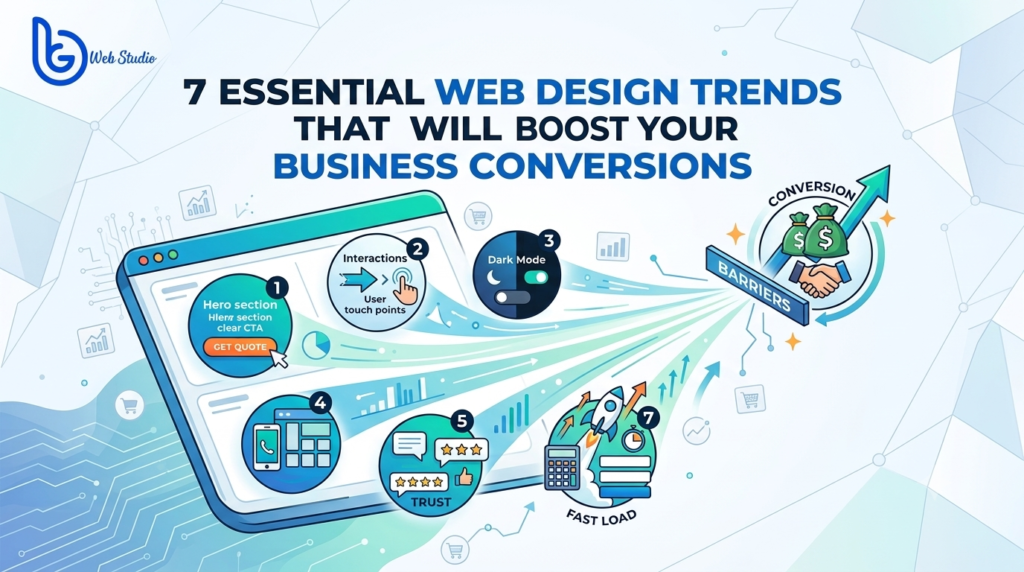
7 Essential Web Design Trends That Will Boost Your Business Conversions
Your website is often the very first interaction a potential customer has with your brand. In today’s digital landscape, having a site that simply looks “nice” isn’t enough. If your web design doesn’t actively guide visitors toward taking action, you are leaving revenue on the table.
Design trends aren’t just about aesthetics—they are about user experience (UX), trust, and clear communication. When implemented correctly, modern design techniques strip away friction, highlight your value proposition, and turn casual browsers into paying clients.
Whether you are planning a full website redesign or looking to polish your current platform, here are seven essential web design trends that directly drive business conversions.
The upper fold of your homepage—the hero section—has roughly three to five seconds to capture attention. Older design trends cluttered this prime real estate with massive sliders, dense text paragraphs, and competing call-to-action (CTA) buttons.
Today’s highest-converting websites favor bold minimalism:
- One core headline: State clearly what you do and who you serve.
- A single primary CTA: Guide the user toward one immediate action (e.g., Get a Free Quote, Book a Call).
- Subtle visual reinforcement: Use high-quality imagery or short loop videos that support your message without distracting from it.
By reducing choices at the top of the page, you eliminate decision fatigue and guide users straight into your conversion funnel.
Micro-interactions are subtle visual feedback cues triggered by user actions. Examples include a button changing color when hovered over, a slight haptic bounce on mobile tap, or a subtle progress bar showing how far a form is completed.
While they might seem decorative, micro-interactions play a crucial psychological role:
- They confirm action: Users immediately know their input was registered.
- They increase engagement: Interactive elements keep visitors on the page longer.
- They direct attention: Motion naturally draws the human eye toward key conversion areas like buttons and contact forms.
When users feel in control of an responsive interface, their trust in your brand increases—and trust is the ultimate conversion driver.
Dark mode is no longer just a stylish preference for tech enthusiasts; it has become an accessibility and engagement standard.
Offering a dark theme or using high-contrast color palettes delivers several business benefits:
- Reduced eye strain: Keeps users browsing comfortably for longer periods, especially during evening hours.
- Visual pop for key elements: High-contrast accents (like bright neon or vibrant brand colors against a dark backdrop) make your primary CTA buttons impossible to miss.
- Energy efficiency: Dark layouts consume less power on mobile OLED screens, keeping visitors on your site longer without draining their batteries.
Designing with accessible contrast ratios ensures your website works seamlessly for all visitors, regardless of their viewing conditions or accessibility needs.
More than 55% of global web traffic comes from mobile devices. If your desktop site looks fantastic but your mobile view requires pinch-zooming, slow scrolling, or tiny clickable links, your conversion rate will suffer.
Adopting a true mobile-first design approach means:
- Designing for touch thumbs rather than mouse cursors (larger buttons, easy tap targets).
- Streamlining navigation menus into simple, accessible drawers.
- Optimizing assets so pages load in under two seconds on mobile networks.
Search engines like Google rank websites based on their mobile performance. A fast, fluid mobile site keeps your SEO rankings high while ensuring mobile visitors convert just as easily as desktop users.
Trust is the single biggest hurdle standing between a visitor and a conversion. Modern web design solves this by embedding social proof directly into the flow of the page rather than hiding it on a dedicated “Testimonials” tab.
Effective ways to integrate social proof include:
- Floating trust badges: Showing client logos or security certifications near CTA buttons.
- Contextual quotes: Placing short, relevant client testimonials right next to the services you are describing.
- Live activity notifications: Displaying subtle pop-ups of recent purchases or project bookings.
Placing proof at exact points where users feel hesitation reassures them right when they are deciding whether to reach out or purchase.
Static text pages are rapidly being replaced by interactive experiences. Users want fast, personalized answers tailored to their specific needs.
Integrating interactive elements—such as cost estimators, quick quizzes, or interactive feature selectors—dramatically increases user engagement.
Example: Instead of listing flat pricing ranges, a web development agency might offer a 3-step project estimator. As the visitor selects their needs, they receive an instant estimate alongside a pre-filled contact form.
Interactive tools accomplish two major goals at once: they deliver immediate value to the user, and they capture highly qualified leads for your sales team.
While speed might sound like a technical detail rather than a design trend, performance is design. The sleekest visual layout in the world won’t convert visitors if the page takes five seconds to load.
Studies show that every additional second of page load time reduces conversions by up to 20%. Modern web design prioritizes speed through:
- Next-gen image formats: Using WebP or AVIF formats for lightweight, high-resolution visuals.
- Clean codebase: Eliminating unnecessary scripts and bloated plugins.
- Lazy loading: Loading images and heavy graphics only as the user scrolls down to them.
Fast-loading websites rank higher on search engine result pages (SERPs) and deliver the seamless experience modern internet users expect.
Web design is no longer just about aesthetics—it is a measurable driver of business growth. By combining minimalist layouts, mobile optimization, interactive elements, and blazing-fast load speeds, you create a digital presence that doesn’t just attract visitors, but turns them into long-term clients.
Ready to elevate your online presence and build a website designed for real business growth? Explore our services at BG Web Studio to see how custom web design and modern strategy can transform your business.