
BG Web Studio

Web Design vs. Web Development: What Does Your Business Actually Need?

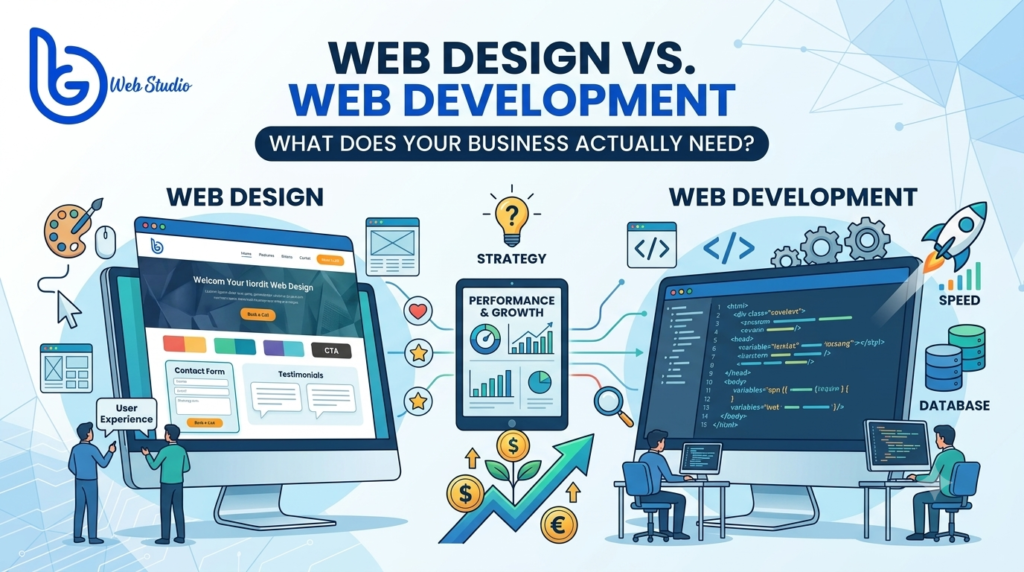
Web Design vs. Web Development: What Does Your Business Actually Need? When you decide to build a new website or revamp an existing one, you will quickly encounter two terms used almost interchangeably: web design and web development. While they sound similar and work hand-in-hand, they refer to two completely different stages of building a website. Confusing the two often leads to hiring the wrong professional, misallocating your budget, or ending up with a site that either looks great but doesn’t function—or functions perfectly but looks outdated. In this guide, we break down the fundamental differences between web design and web development, explain how they impact your business growth, and help you determine what your project actually needs. What is Web Design? (The Visuals & Experience) Web design focuses on everything a user sees, feels, and interacts with on the screen. It is equal parts visual art, user psychology, and brand strategy. A skilled web designer doesn’t just make a site look visually appealing; they structure information so visitors can intuitively navigate your pages, trust your brand, and take action. Key Responsibilities of a Web Designer: In simple terms: If your website were a house, web design would be the architecture, interior decoration, lighting, and paint colors. What is Web Development? (The Engine & Structure) Web development is the technical backbone that brings a designer’s vision to life. Developers turn static design mockups into functional, interactive, and secure web pages using programming languages. Without web development, a website design is just an image file. Developers write the code that makes buttons clickable, contact forms submit, shopping carts calculate totals, and pages load quickly. Web development is generally split into three main disciplines: 1. Front-End Development Front-end developers write the code (HTML, CSS, JavaScript) that renders the visual design in a web browser. They ensure the design scales properly across desktop screens, tablets, and mobile smartphones. 2. Back-End Development Back-end developers handle the server side of the website—databases, server logic, API integrations, and security protocols. They ensure that when a customer submits a form or buys a product, the data is processed securely behind the scenes. 3. Full-Stack Development Full-stack developers are proficient in both front-end and back-end development, capable of managing a website project end-to-end. In simple terms: If your website were a house, web development would be the foundation, plumbing, electrical wiring, and structural support. Web Design vs. Web Development: A Quick Comparison Feature Web Design Web Development Primary Focus Look, feel, user flow, aesthetics Functionality, code, site speed, security Core Tools Figma, Adobe XD, Photoshop, Illustrator HTML, CSS, JavaScript, PHP, MySQL Key Objective Engage visitors & convert them into leads Ensure site stability, speed & seamless performance Main Deliverable Visual mockups, wireframes, prototypes Functional codebase, live database, custom plugins What Does Your Business Actually Need? Determining whether you need a designer, a developer, or both depends on the current state of your website and your upcoming business goals. You Need a Web Designer If: You Need a Web Developer If: You Need Both (A Full-Service Web Agency) If: Why Choosing a Full-Service Agency Saves Time and Money Hiring a standalone designer often leaves you with beautiful graphics that no one knows how to code. Conversely, hiring a developer alone can result in a lightning-fast website that looks like it was built in 2005. Working with an integrated team—like BG Web Studio—bridges the gap. When designers and developers work together under one roof, your website receives the perfect balance of visual aesthetics, seamless conversion strategy, and rock-solid technical execution. Final Thoughts: Building a Digital Asset That Grows Your Business Web design and web development are not opposing choices—they are complementary halves of a successful digital presence. Design attracts and engages your target audience, while development delivers the speed, security, and functionality they expect. Ready to build a website that combines captivating design with high-performing technology? Explore our custom design and development solutions at BG Web Studio today.

Web Design vs. Web Development: What Does Your Business Actually Need? Read More »
How Much Does a Custom Website Cost? A Complete Guide for Small Businesses

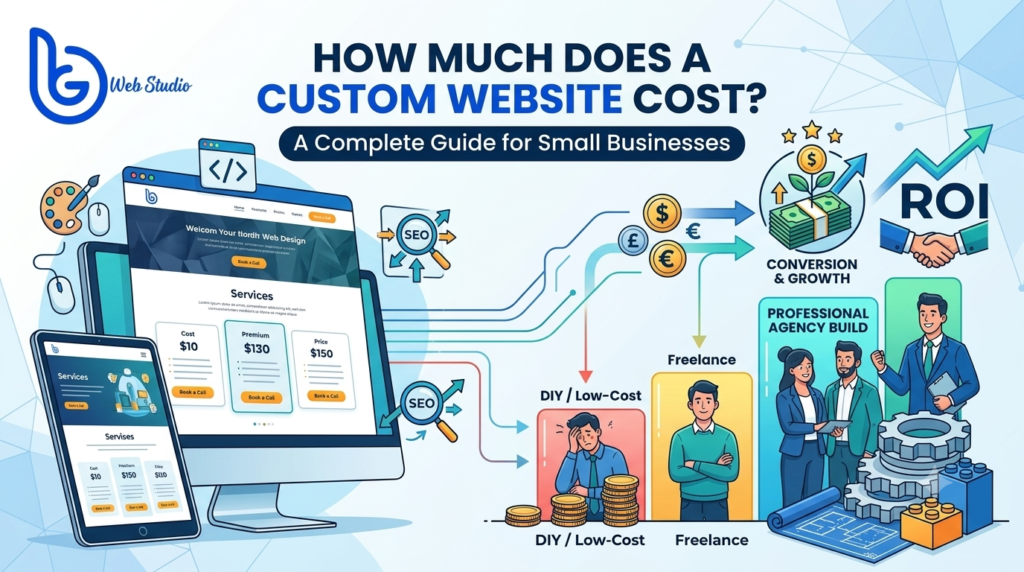
How Much Does a Custom Website Cost? A Complete Guide for Small Businesses Asking “how much does a website cost?” is a lot like asking “how much does a house cost?” The final price tag depends entirely on the size, location, materials, and specific features you choose. For small business owners, website pricing can feel notoriously confusing. You might speak to three different agencies and receive quotes ranging from $500 to $15,000 for what seems like the exact same request. This guide cuts through the confusion. We break down realistic cost tiers, explain what drives website pricing, and highlight hidden costs so you can make an informed investment for your business. The 4 Main Website Cost Tiers To help you plan your budget, custom websites generally fall into four distinct pricing tiers depending on who builds them and what features they include: Tier 1: DIY Website Builders ($100 – $500 / year) Platforms like Wix, Squarespace, or basic WordPress.com templates allow business owners to build a site on their own. While upfront costs are low, you pay with your time. DIY sites often come with design limitations, slower load speeds, and rigid structures that make scaling difficult. Tier 2: Freelance Developers ($1,500 – $4,000) Hiring an independent freelancer is a popular choice for local businesses. A skilled freelancer can deliver a clean, customized 5-to-10-page website. However, availability post-launch can be hit-or-miss if the freelancer takes on new projects or changes careers. Tier 3: Specialized Web Studios & Agencies ($3,000 – $10,000+) Partnering with a specialized web agency—like BG Web Studio—gives you access to a team of experts: designers, developers, copywriters, and SEO specialists. At this level, you aren’t just buying code; you are investing in conversion strategy, custom branding, and a platform built to generate revenue. Tier 4: Enterprise & Custom Web Platforms ($15,000+) Large-scale businesses with extensive product catalogs, custom software integrations, complex membership portals, or advanced web applications require enterprise-level budgets. 5 Key Factors That Drive Custom Website Pricing Why do web design quotes vary so drastically? These five core factors dictate the total project investment: 1. Custom Design vs. Pre-Made Templates A pre-made template forces your content into a pre-existing layout. A custom web design starts from a blank canvas tailored to your brand identity, target audience, and specific user journeys. Custom designs take more time to map and build, but they perform significantly better in terms of conversions and user experience. 2. Page Count and Scope A simple 5-page site (Home, About, Services, Blog, Contact) requires far less labor than a 30-page site with individual landing pages for every service and location you cover. More pages mean more layout design, asset optimization, and content entry. 3. Functionality and Features Specialized features add development hours to a project. Standard marketing sites cost less than platforms requiring: 4. Technical SEO and Mobile Optimization A great website must be easily discoverable on search engines. High-quality web agencies include foundational SEO in their build process—optimizing site architecture, page speed, schema markup, mobile responsiveness, and metadata. Skipping this step means paying extra for SEO fixes later on. 5. Content Creation and Copywriting If you provide all the text and high-resolution photography yourself, your build cost will be lower. However, if you rely on the web agency to write persuasive sales copy, source stock imagery, or shoot custom photos, those professional services will be factored into the overall quote. Hidden Costs Most Small Businesses Forget When setting your web design budget, don’t forget to account for recurring infrastructure costs: Is a Custom Website Worth the Investment? It is easy to view a website as an expense, but the right website is an active sales representative that works for your business 24 hours a day, 7 days a week. A cheap or outdated website can actually cost you money in lost leads and missed client opportunities. Conversely, a custom, performance-focused website builds immediate credibility, answers prospect questions, and converts traffic into high-value clients. A cheap or outdated website can actually cost you money in lost leads and missed client opportunities. Conversely, a custom, performance-focused website builds immediate credibility, answers prospect questions, and converts traffic into high-value clients. Pro Tip: When evaluating quotes, don’t just look at the bottom line. Ask agencies what business problem their design process solves and how they plan to help you track ROI. Getting Started with Your Website Project The best way to figure out exact costs for your business is to define your goals before reaching out for quotes. Know what you want your website to accomplish—whether that’s getting more phone calls, booking client consultations, or selling products directly online. Ready to invest in a strategic, custom website designed to scale your business? Contact the team at BG Web Studio today for a transparent quote and a personalized project roadmap tailored to your budget.

How Much Does a Custom Website Cost? A Complete Guide for Small Businesses Read More »